
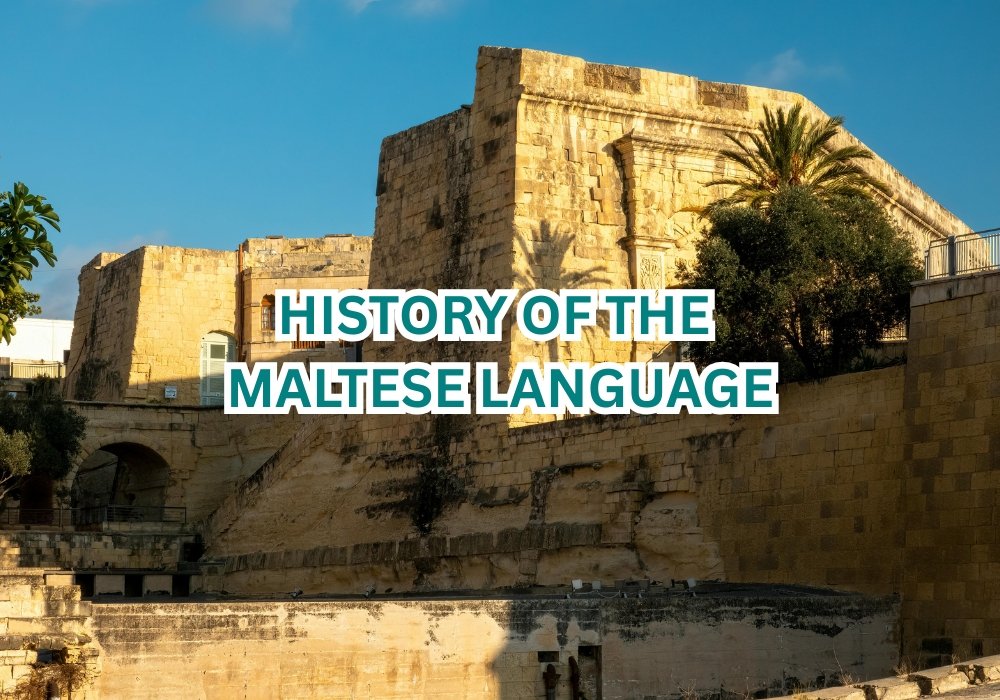
The Malta language, better known as Maltese, is one of Europe’s most fascinating linguistic stories. Spoken by just over half a million people, Maltese is the only Semitic language written in the Latin alphabet and the only Semitic language that is an official language of the European Union. Its history reflects centuries of migration, conquest, […]
The Malta language, better known as Maltese, is one of Europe’s most fascinating linguistic stories. Spoken by just over half a million people, Maltese is the only Semitic language written in the Latin alphabet and the only Semitic language that is an official language of the European Union. Its history reflects centuries of migration, conquest, trade, and cultural exchange in the Mediterranean.
For language enthusiasts, understanding the history of Maltese is more than learning about words and grammar—it is about discovering how civilizations shaped a living language that continues to evolve today. In this article, we explore the origins, development, and modern status of the Malta language, from its ancient roots to its role in contemporary Maltese society.
The Malta language holds a truly unique position in the linguistic landscape of Europe. While most European languages descend from Indo-European roots, Maltese belongs to the Semitic language family, closely related to Arabic and Hebrew. At the same time, it has absorbed strong influences from Romance and Germanic languages, especially Italian and English.
What makes Maltese remarkable is this blend of identities:
Semitic grammar and core vocabulary
Latin-based alphabet
Extensive Romance and English loanwords
This linguistic fusion mirrors Malta’s geographical location—situated at the crossroads of Europe, North Africa, and the Middle East. The history of Maltese is inseparable from the island’s strategic importance over the centuries.
The foundation of the Maltese language can be traced back to Siculo-Arabic, a form of Arabic spoken in Sicily and Malta between the 9th and 13th centuries. When Arab settlers arrived in Malta around 870 CE, they introduced a variety of Arabic that would become the backbone of modern Maltese.
Key characteristics inherited from Arabic include:
Root-based word formation
Verb conjugation patterns
Pronunciation of certain guttural sounds
Unlike Arabic dialects elsewhere, Maltese evolved in relative isolation after the Norman conquest. While Arabic disappeared from Sicily, it survived and transformed in Malta, gradually becoming distinct from other Arabic varieties.
According to historical linguists and sources such as Encyclopaedia Britannica, Maltese is the only surviving descendant of Siculo-Arabic, making it a linguistic treasure with no direct parallel in the modern world.
👉 Learn more about its classification from this historical authority: https://www.britannica.com/topic/Maltese-language
As Malta came under Norman and later European rule, the Malta language absorbed heavy Romance language influence, particularly from Sicilian and Italian. For centuries, Italian was the language of administration, culture, and education in Malta.
This period contributed:
Vocabulary related to law, arts, and administration
Expressions used in daily life
A softer phonetic tone compared to Arabic dialects
Examples of Italian-derived Maltese words include terms for food, music, emotions, and social life. While the grammatical structure remained Semitic, the growing Romance vocabulary gave Maltese a hybrid character.
This blending did not weaken the language. Instead, it made Maltese more adaptable and expressive, allowing it to evolve alongside changing political realities.
British rule, which began in 1800, marked another turning point in the history of the Malta language. English quickly became the language of government, education, and international communication.
As a result, Maltese incorporated:
English technical and administrative terms
Modern vocabulary related to science and technology
Bilingual usage among speakers
Today, Malta is officially bilingual, with Maltese and English sharing equal legal status. Many Maltese speakers naturally switch between the two languages, a phenomenon known as code-switching.
Despite English influence, Maltese did not disappear. Instead, it gained prestige as a national symbol, especially during Malta’s movement toward independence.
For centuries, Maltese existed mainly as a spoken language. The standardization of the Malta language began in earnest during the 19th and early 20th centuries.
Important milestones include:
Development of a standardized alphabet based on Latin letters
Introduction of special characters such as ċ, ġ, ħ, and ż
Publication of grammars and dictionaries
Recognition of Maltese as an official language in 1934
The Maltese writing system is designed to represent Semitic sounds accurately while remaining readable for Latin-script users. For a detailed explanation of the alphabet and spelling system, this resource is highly recommended:
👉 https://www.omniglot.com/writing/maltese.htm

History of the Maltese Language
In 2004, Maltese achieved a historic milestone when it became an official language of the European Union. This recognition confirmed the language’s importance on an international stage.
Today, the Malta language is used in:
Government and legal documents
Education at all levels
Media, literature, and digital platforms
EU translations and parliamentary proceedings
This modern status ensures that Maltese continues to grow while remaining protected by language policies and educational institutions.
Understanding the history of the Malta language helps learners make sense of its structure and vocabulary. When you know why Maltese grammar feels different from Italian—or why Arabic roots appear alongside English words—learning becomes easier and more enjoyable.
Benefits for learners include:
Better vocabulary retention through historical context
Improved pronunciation awareness
Deeper cultural understanding
If you are interested in applying this historical knowledge to real communication, structured learning is essential. You can explore Maltese courses designed for adults here:
👉 https://lingua-learn.mt/adults/maltese/
For a broader overview of language learning opportunities and cultural programs, visit the main Lingua Learn website:
👉 https://lingua-learn.mt/
To summarize its evolution, here are the defining features of modern Maltese:
Semitic core grammar
Latin alphabet with unique letters
Vocabulary influenced by Arabic, Italian, Sicilian, and English
Official status in Malta and the EU
This combination makes Maltese both challenging and rewarding for language enthusiasts.
Maltese grammar is closer to Arabic, while much of its vocabulary—especially cultural and administrative terms—comes from Italian and English.
Due to European influence and Christian rule, Maltese adopted the Latin alphabet, adapting it to represent Semitic sounds accurately.
For speakers of European languages, Maltese grammar may feel unfamiliar, but shared vocabulary from Italian and English makes learning easier.
Maltese began developing around the 9th century, making it over 1,000 years old.
Yes. With guided instruction and cultural context, many learners successfully master conversational Maltese.
The story of the Malta language is a story of survival, adaptation, and identity. From its Arabic roots to its European present, Maltese stands as a living record of Malta’s complex history. It is not just a means of communication, but a symbol of national pride and cultural continuity.
For language enthusiasts, learning Maltese opens the door to understanding the Mediterranean world in a deeper, more meaningful way. If you are inspired by its history and want to take the next step, now is the perfect time to start learning.
Begin your Maltese language journey with expert guidance at Lingua Learn and experience the language where history meets modern life.