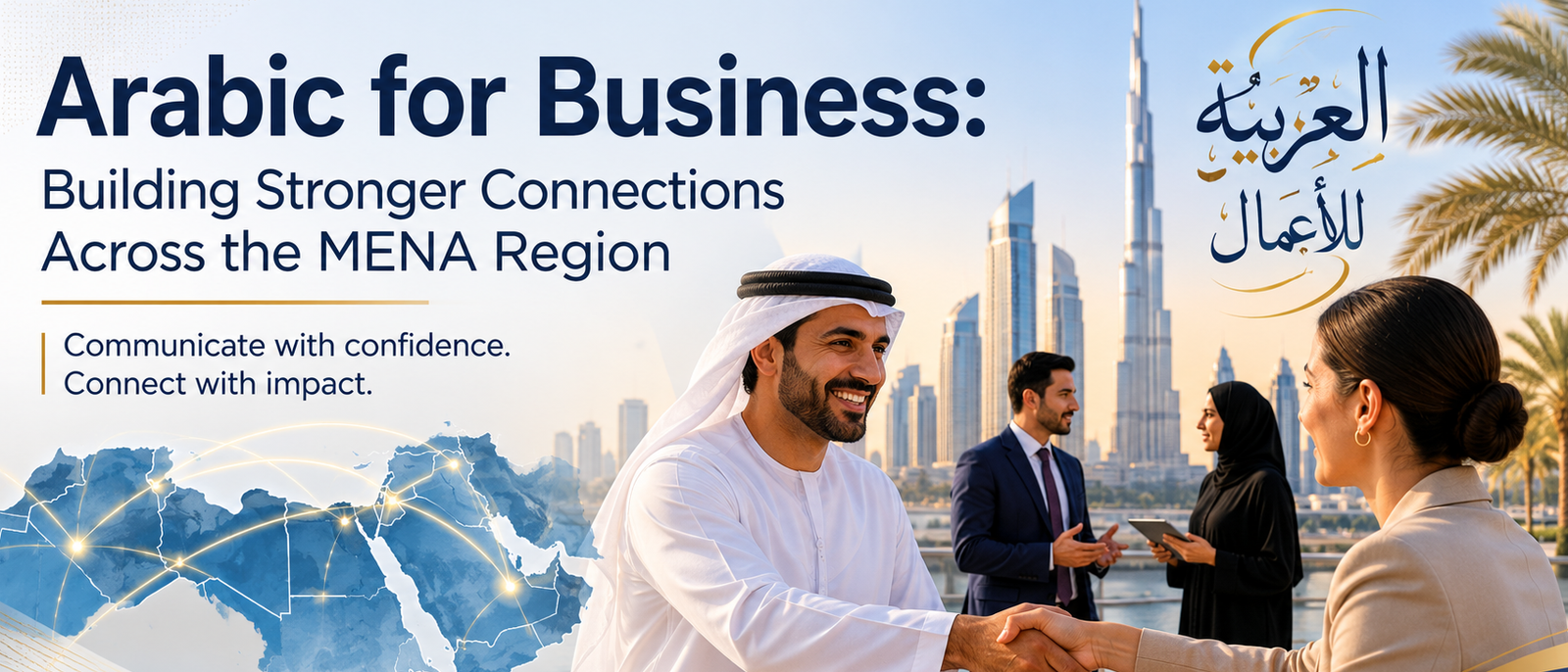
Arabic for Business: Building Stronger Connections Across the MENA Region As organisations expand their presence across the Middle East and North Africa (MENA), effective communication becomes increasingly important. Whether engaging with clients, suppliers, investors, partners or customers, the ability to communicate in Arabic can help organisations build stronger professional relationships and navigate business interactions with […]
As organisations expand their presence across the Middle East and North Africa (MENA), effective communication becomes increasingly important. Whether engaging with clients, suppliers, investors, partners or customers, the ability to communicate in Arabic can help organisations build stronger professional relationships and navigate business interactions with greater confidence.
Lingua Learn Malta provides flexible online Arabic language training designed specifically for professionals and organisations. Our programmes help employees develop practical communication skills that support business activities across Arabic-speaking markets.
Arabic is one of the world’s most widely spoken languages and is used across a diverse range of economies throughout the Middle East and North Africa. As organisations pursue new opportunities in the region, language and cultural understanding can become valuable assets.
While English is often used in international business environments, the ability to communicate in Arabic can help create stronger connections and demonstrate a commitment to understanding local markets and business practices.
The Middle East continues to attract significant international investment and commercial activity. Recent analysis of Gulf markets highlights ongoing business expansion, infrastructure investment and economic diversification initiatives across the region, creating new opportunities for organisations operating internationally. A recent Reuters report highlighted continued expansion and investment activity in the UAE, underlining the scale of economic development taking place across the Gulf region.
Businesses operating in sectors such as finance, technology, logistics, education, healthcare, hospitality, energy and professional services frequently interact with Arabic-speaking stakeholders. Developing language skills can support more effective communication and help strengthen long-term partnerships.

Effective Arabic communication skills can help organisations build stronger relationships across MENA markets
Language plays an important role in building trust and rapport. Employees who understand Arabic business communication can often engage more effectively with clients, partners and colleagues throughout the region.
Corporate Arabic training can help teams:
For organisations serving Arabic-speaking customers or partners, language skills can contribute to a more personalised and responsive experience.
Employees may be better equipped to:
Successful communication extends beyond vocabulary and grammar. Understanding cultural expectations, business etiquette and communication styles can help organisations avoid misunderstandings and build stronger working relationships.
Arabic language training can provide valuable insights into the cultural context that influences business interactions across the region.
Modern organisations require training solutions that fit around operational priorities. Online learning enables employees to develop language skills without the need for travel or lengthy disruptions to their schedules.
Live online training sessions provide flexibility while maintaining interaction, engagement and opportunities for practical language development.
Whether training a single employee, a leadership group or a larger team, online delivery provides a flexible and scalable solution.
Programmes can support:
For organisations with employees working across different offices, countries or time zones, online delivery ensures a consistent learning experience regardless of location.
This allows teams to participate in training while maintaining productivity and meeting business commitments.
Our Arabic language programmes focus on real-world workplace communication and can be tailored to specific organisational needs.
Training topics may include:
Rather than focusing solely on academic language learning, training is designed to help employees use Arabic in practical business situations.
Participants develop skills that can be applied to:
Programmes are available for learners at different stages, from complete beginners to professionals seeking to strengthen existing Arabic language capabilities.
This allows organisations to provide targeted learning pathways that align with individual and team objectives.
Every organisation has unique communication requirements. Effective corporate Arabic training should reflect specific business goals, industry contexts and learner needs.
Training can be customised to support:
By focusing on relevant business scenarios, organisations can ensure that learning remains practical, engaging and aligned with workplace objectives.
As organisations continue to develop relationships across the Middle East and North Africa, strong communication skills can support more effective engagement with clients, partners and stakeholders.
Arabic language training helps employees build confidence, improve communication and develop a deeper understanding of the cultural context in which business takes place.
Through flexible online delivery and business-focused content, organisations can equip their teams with practical language skills that support professional growth and international business objectives.
To learn more about Arabic for business Malta programmes or discuss customised corporate Arabic training for your organisation, contact Lingua Learn Malta for a sales enquiry. Our team can help identify a training solution aligned with your business goals and workforce development needs.