
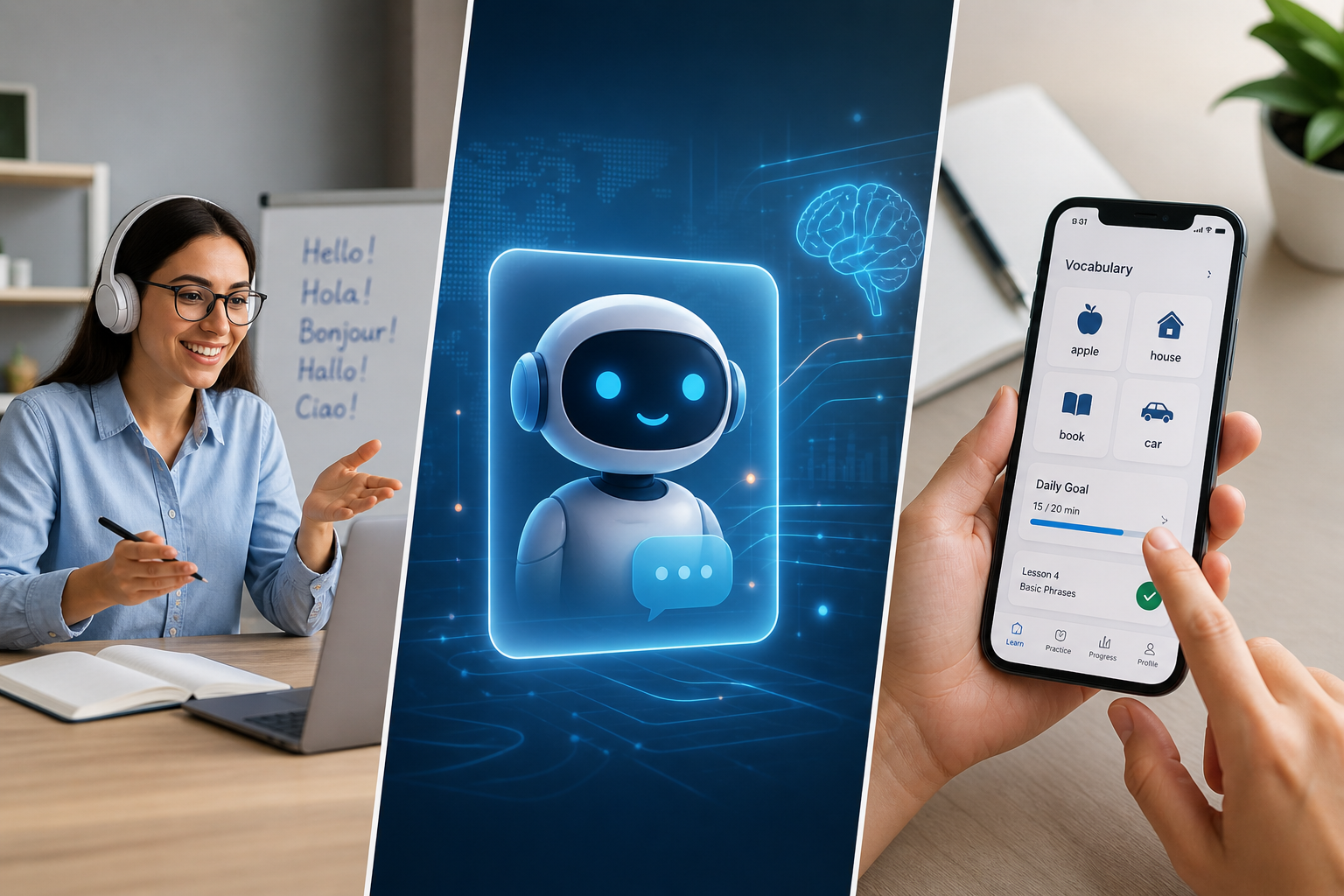
In today’s rapidly evolving digital learning landscape, organisations are increasingly asking a practical question: what is the most effective way to learn a language? With the rise of artificial intelligence tools, mobile language apps, and traditional live instruction, choosing the right approach has become more complex than ever. This article explores the comparison between Real […]
In today’s rapidly evolving digital learning landscape, organisations are increasingly asking a practical question: what is the most effective way to learn a language? With the rise of artificial intelligence tools, mobile language apps, and traditional live instruction, choosing the right approach has become more complex than ever.
This article explores the comparison between Real Teacher vs AI vs language apps, helping decision-makers understand which method delivers the strongest outcomes for corporate language development and workplace communication.
Table of Contents
ToggleBefore comparing effectiveness, it is important to understand how each method works in practice.
A real teacher-led approach involves structured instruction delivered by a qualified language trainer, typically through live online or in-person sessions. In corporate settings, this is often tailored to business needs such as meetings, presentations, negotiations, customer service, or industry-specific communication.
Live instruction is usually interactive and adaptive, allowing learners to practice speaking in real time and receive immediate feedback.
AI-driven tools use algorithms to simulate conversation, correct grammar, and personalise exercises based on user performance. These platforms adapt quickly and offer instant feedback, making them attractive for self-paced learners.
However, AI systems typically rely on pre-programmed responses and pattern recognition, which can limit their ability to replicate complex, unpredictable business interactions. Research supports this limitation. A survey study by Tin et al. (2025) found that while AI can personalise learning and provide instant feedback, both students and teachers expressed concerns about its lack of emotional intelligence and inability to fully replicate human interaction in learning environments.
Language apps provide structured bite-sized lessons, often focusing on vocabulary, listening, and basic grammar. They are widely used due to convenience and accessibility.
While useful for beginners, they are generally designed for individual practice rather than professional communication or workplace fluency.
When evaluating Real Teacher vs AI vs language apps, organisations typically focus on effectiveness, engagement, adaptability, and real-world application.
A real teacher remains the most effective option for developing professional communication skills. This is especially important in corporate environments where employees must use language confidently in meetings, presentations, and client interactions.
For example, a customer support team dealing with international clients benefits significantly from live role-play sessions that simulate real conversations, rather than isolated app exercises.
Language learning becomes more effective when it is tailored to job roles, industries, and communication goals.
In corporate environments where employees may need English, French, German, or other languages depending on their role, real teachers can adjust content dynamically to reflect real workplace requirements.
Sustained engagement is one of the biggest challenges in language learning.
Live sessions encourage participation, dialogue, and correction, which helps learners stay motivated and progress more consistently.
One of the most important considerations for businesses is whether learning translates into improved workplace performance.
For example, a sales professional preparing for international client meetings will benefit more from practicing negotiation scenarios with a trainer than from memorising phrases in an app.
When considering the best way to learn a language, the answer depends on the learner’s objective.
For casual learners, apps and AI tools can provide a useful introduction to vocabulary and grammar. However, for professionals and organisations focused on workplace communication, structured learning with a real teacher remains the most effective approach.
The key reason is simple: language is not just knowledge—it is a skill. Skills are developed through interaction, correction, repetition, and guided practice.
Rather than viewing these methods as competitors, many organisations are now adopting blended learning models.
A hybrid approach typically includes:
This combination allows learners to benefit from flexibility while still maintaining high-quality human guidance.
For instance, employees in a multinational company might use an app for daily vocabulary practice, AI tools for quick grammar reinforcement, and weekly live sessions with a trainer to practice real workplace conversations.
Despite technological advancements, the role of the real teacher remains central in effective language acquisition, especially in professional environments.
Language is shaped by tone, context, and cultural nuance. A real teacher can explain not only what is grammatically correct, but what is appropriate in different professional situations.
This is particularly valuable in international business settings where communication style can influence relationships and outcomes.
As highlighted in a recent BBC analysis on language learning, achieving fluency depends heavily on sustained interaction, cultural understanding, and real-world communication rather than isolated study methods. This is further supported by Tin et al. (2025), where both educators and learners highlighted that AI lacks the emotional intelligence and contextual awareness needed for effective communication in real-world settings.
Real teachers follow structured learning pathways aligned with business objectives, ensuring consistent development rather than fragmented or self-directed learning.
This structured approach is especially important for organisations aiming to measure progress over time.
Live instruction ensures learners stay engaged, complete tasks, and progress steadily. This level of accountability is often missing in self-paced tools, where motivation can vary significantly.
For decision-makers, the choice depends on training objectives and expected outcomes:
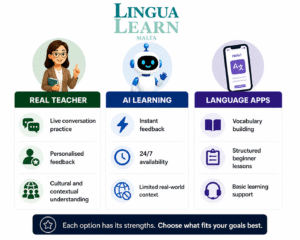
Real Teacher vs AI vs Language App
Most organisations achieve the strongest results by combining all three approaches, with real teachers forming the core of the learning experience.
The comparison of Real Teacher vs AI vs language apps is not about identifying a single superior method, but about understanding how each method contributes to language development.
While AI and apps offer convenience and accessibility, they cannot fully replicate the depth, adaptability, and human interaction provided by experienced trainers. For organisations focused on improving workplace communication, collaboration, and confidence, structured live training remains the most reliable and effective approach.
Selecting the right combination of tools can significantly improve learning outcomes, particularly when aligned with clear business goals.
If your are exploring the best way to learn a language, Lingua Learn can help design a tailored training solution that combines flexibility with measurable learning outcomes.
📞 Lingua Learn Malta
🌐 https://lingua-learn.mt/
📱 +356 7712 6492
📧 learning@lingua-learn.mt